
Throughout history, and still today, the privileged class has used the energy of ordinary people — past and present. Not metaphorically or conceptually. In fact. As though they were coal.
Physically, energy is a nucleus, a whole with two polarities: positive and negative. Technically, neither exists beyond the other. Sociologically, however, things are no longer symmetrical.
As I came to understand, after leaving my marriage, that people do not know how to let go, and so they are willing to quarrel and wound each other in the most dreadful ways when love no longer exists — simply because the volume of negative stimulus comes to equal or even exceed the positive that is no longer there. And because everything unfolds on the same wavelength. It is still intimacy.
By analogy, to collect the maximum energy produced by the opposite of love within the human being is the most powerful form of control. Because without free will, without the possibility of disjunction, a person does not stop. They carry their expression through to implosion.
Love is like the positive terminal of a battery. When a strong person does not have — or no longer has — that positive, they will open the valve of the negative and feed it on the principle of communicating vessels, until it reaches the value of the original positive and even surpasses it. Following the Romanian maxim: “I made you, I can destroy you.” And in this way we forget that love itself still exists, in its entirety.
In reality, both polarities coexist. Yet power is exercised through the control of one and the removal of the other from collective understanding.
I wonder: when did we forget to nourish ourselves with love, through knowledge? And how did we come to function almost exclusively on fear and terror?
As a child, I spent my first five years living solely with my grandparents. Then they passed away.
From the age of five and a half, I lived with my parents. And with that, I came to know my mother. And her daily slap.
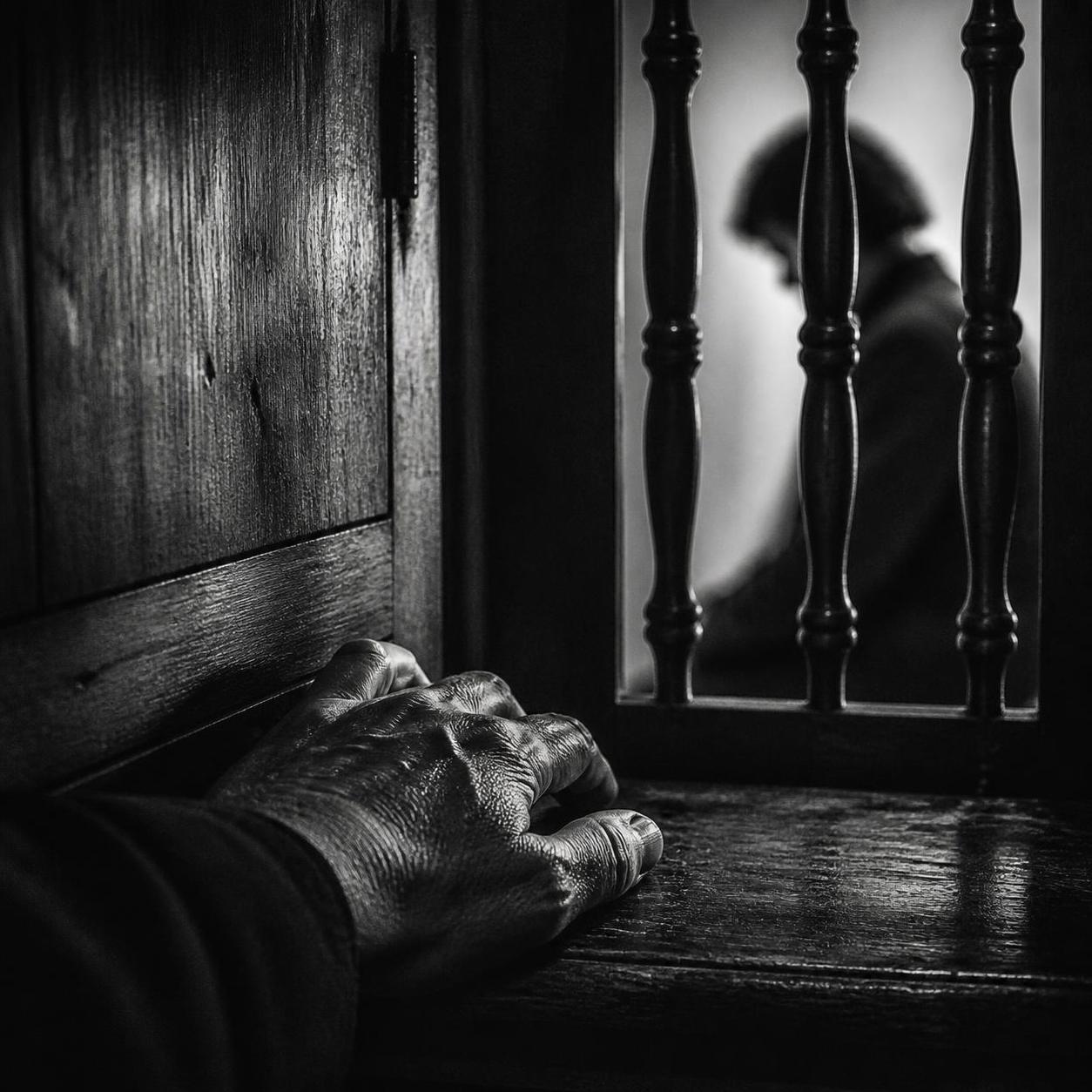
At around six, I entered a church without purpose — during a game of hide-and-seek. It was then that I learned I was doing rather well in the “daily beating” department at my mother’s hands. There are parents who kill their children out of a sense of divine calling. There are brothers who smash each other’s heads in, even though they are the only adolescents on earth. And when God becomes angry and resets everything, only Noah’s family and the other species survive. Not other people’s children.
Ah. I nearly forgot. And woman is, basically, a whore.
From this ideologically blinkered vantage point, intoxicated with the plum brandy of rage, with four years of schooling, I ask myself: whose damned idea was it to invent “confession”?
And all of this with the background marketing of Orthodoxy: you — the feeble one, the powerless one, unworthy of love.
As a bitter irony to the entire Orthodox-Christian platter I swallowed throughout my life, the first time I carefully studied the meaning of the verb “to forgive” was around the age of forty. My life has been entirely transactional. “Forgiveness” seems to me a foreign marketing instrument from which I have not benefited. Precisely for this reason, I thought I could study it epistemically, without fits of weeping. Where nothing exists, not even God provides. Checkmate.
At the opposite pole — not of religion itself, but of this platter of “boeuf salad” without beef — stands a story from Ancient Greece.
About a Minotaur. About his creation, his life, and the world around him.
Beginning with depraved, ordinary, deeply worldly parents — which is how a child with a bull’s head came into being. And leading to the manifestation of their love, in its most brutal and concrete form.
A story about parents who order the construction of the largest labyrinth in the world and place their deformed child at its centre. The labyrinth still exists. It is in Crete.
But the story has been overturned. We are left with the convenient idea that the monster was at the centre. Not with the reality that the walls were raised to keep people away from the monster. Or perhaps to keep the monster away from people.
And the story continues.
Into the labyrinth is placed the very man who built it: Daedalus. And not only him — his son as well, Icarus.
From here, it is no longer about punishment. It is about parental love.
And about an exhortation that popular Christianity has never uttered again, not even as a possibility:
“Fly beside me, Icarus. Do not drift away. Too close to the sun and the wax will melt. Too low and you will be crushed by the water as if against a wall. Fly beside me.”
Did Icarus do so? Did he listen? Of course not.
But the difference remains colossal.
The journey is everything. In the end, we all strike the pavement.
People are not controlled through a lack of energy, but through its diversion into destructive forms, and the systems that monopolise this conversion become dominant. The only alternative that remains is lucid balance.






Leave a Reply